

The Empyrean cannot be performed live. Frusciante overdubbed guitars, synths, and his own voice so extensively (occasionally joined by Flea, Johnny Marr, a choir) that the record exists only as a record. The track names map a journey. “Before the Beginning” opens the album, “Central” sits roughly in the middle, “After the Ending” closes it. The cover shows layers of what feels like consciousness ascending toward what I think is Dante’s heaven. The album follows a mind through death and dissolution toward something like peace.
Les Mondes d’Aldébaran is a bande dessinée series by Léo about human colonies on alien planets. Blues from wine-dark to electric, greens from jungle to verdigris. Interesting worldbuilding, a reference in the planet opera genre. But most importantly: names. Places and animals with names that sound like somewhere else. Robledo. Betelgeuse. Alvin Benevides.
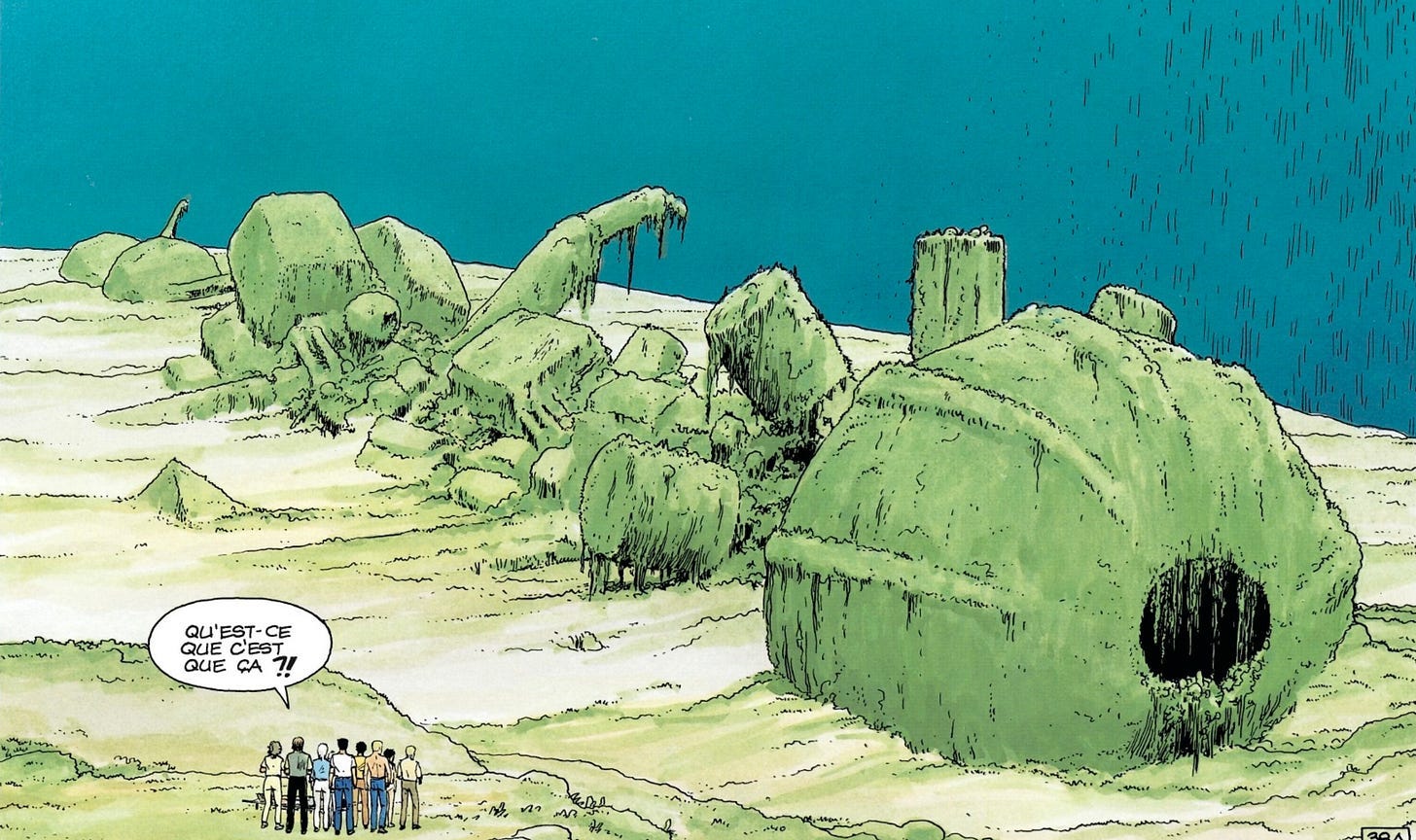
Image: Léo / Dargaud
One is a guitar record about death and transcendence. The other is a bande dessinée about alien ecology and colonial ambition. They have nothing in common except this: when I listen to “Heaven” while reading La Créature, I get goosebumps. Not from either alone. From both.
I found both the same year, at seventeen, in the Vosges, through headphones I couldn’t really afford.
The Test
Getting into what.cd required you to pass an exam first, proving you understood digital sound. Bitrates. File formats. Audiograms. Waveforms. The audible spectrum. Lossy versus lossless compression. I took the test on a hackintosh built from dump parts. Salvaged motherboard, scavenged RAM, macOS installed on hardware Apple never blessed.
I passed. The test was technical, and I’d been technical since ten. Dump motherboards, hackintosh installs, the kind of knowledge you get from having no pocket money and too much time. Elation, in those years, was finding a motherboard with an Intel GMA 950 in a pile of e-waste. The Sony MDR-7506 came from the same economy. The most expensive thing I owned at seventeen, a whole birthday’s worth of headphones.
Suddenly I had access to everything in FLAC. Not mp3s ripped from YouTube. Not the compressed files everyone else streamed. Quality. I spent time on /mu/, the 4chan music board, where I learned to listen to whole albums instead of singles. I learned about concept albums. I learned about Frusciante’s life: his heroin years, his departure from the Red Hot Chili Peppers, the hermit period where he made music alone. I found Invisible Movement, the fan site named after one of his earlier songs. That site became my encyclopedia for understanding his work.
The collecting had a second purpose. I was sixteen, seventeen, and wanted to stop being the weird kid. The fear underneath was that if I stopped accumulating beautiful things, I’d disappear. That I was only worth noticing if I had something to show.
I started listening to John Frusciante’s “The Past Recedes” on YouTube. Then downloaded his whole discography in FLAC (sorry) and listened properly.
John Frusciante — “The Past Recedes”, from Curtains (2005). The song that started it.
Heaven, Part Two
I listened to the album alone. Dimmed the lights. Evenings after school. The way Frusciante said to. I felt ugly and lost. Not dramatically, just the ordinary teenage edgyness.
The song “Heaven” is okay in the beginning. Pleasant. Atmospheric. But then, around the second part, there’s a buildup. Slowly, things start shifting. And then Frusciante sings: “When I speak to you again through the stages of pleasure”
Not the words, but the way he sings them. The strings opening up after a bass-heavy segue, the way the layers reveal themselves. Goosebumps. Intense feelings. Sadness. Longing. Something sublime happening against a backdrop of loss.
John Frusciante — “Heaven” at 2:31. The moment the layers open.
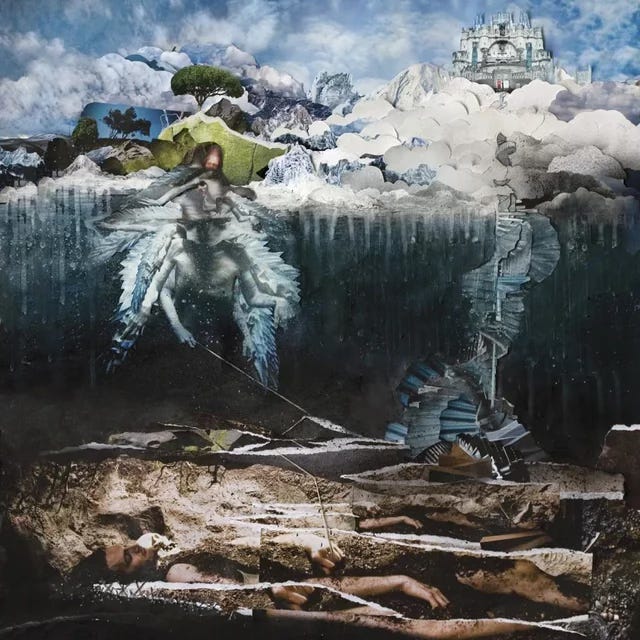
Image: John Frusciante / Record Collection
My favourite track was “Central”, my most-played song on last.fm for nine consecutive years. It’s the most stratified song on the album, sitting exactly in the middle of the character’s story. Track five, “Dark/Light”, splits the album tonally. “Central” is the axis. There’s always something new to discover depending on which part you focus on. I remember listening once and focusing entirely on the bass line. I rediscovered the song. That’s what FLAC quality gave you: the ability to choose which layer to hear. The album cover made this explicit. The ascent to the empyrean, blue sky and gold sediment, geological time compressed into pattern. Dante’s heavens rendered as atmosphere.
The album ends with “After the Ending”, voices processed with effects until they sound otherworldly. The perfect sonic companion to a planet opera about discovery.
I discovered the Dante connection reading about the album online. I felt obligated to read the Divine Comedy. Years later, I did. It was fine. Admirable, canonical, dead. Too many self-inserts. Dante’s bitterness in written form. Dante hates someone, so that person goes to hell. Boring. Unimaginative. Maybe a lot was lost in translation. But the truth is: I had way more feelings listening to Frusciante than reading Dante.
The Names That Sound Like Elsewhere
Les Mondes d’Aldébaran arrived in my life the same way. Late high school. The same hunger for beautiful things.
Léo’s art: lush planets teeming with life, planets that we hope Humanity discovers one day. But what really moved me were the names. Robledo. Doesn’t that sound like a beautiful city? Paracelse, Éleutère Géant. La Mantrisse, something “beyond men”. The names were music. They sounded like they meant something before you understood what they meant.
The opening panel of the series shows the “Benevides transfert”. I’m not sure about the scientific accuracy of this method of space travel, but “Alvin Benevides” is a beautiful name. The kind of name that makes you feel like you’re somewhere else.
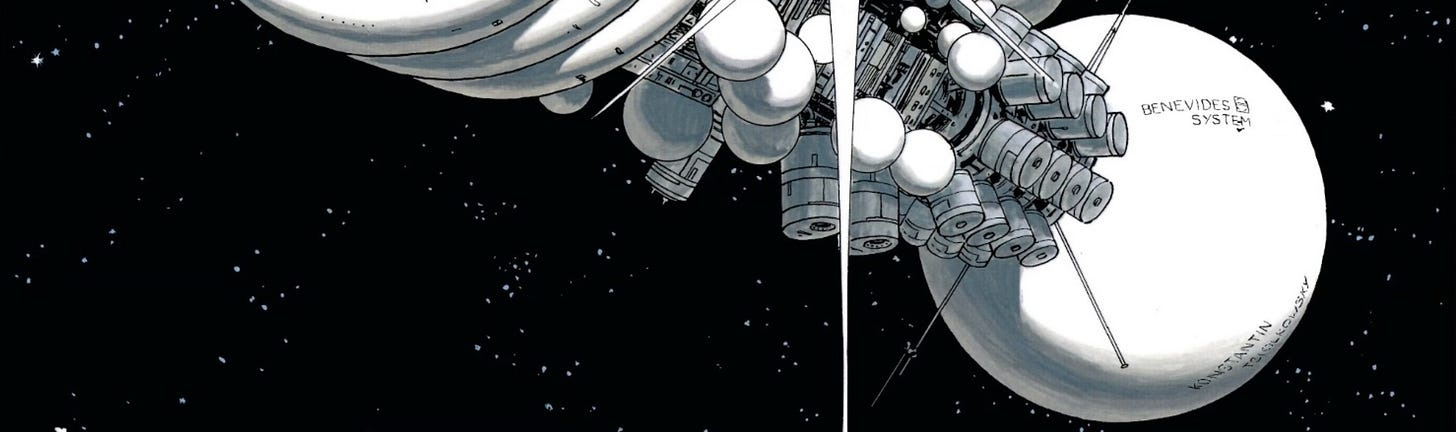
Image: Léo / Dargaud
And the paysages. Looking at Aldébaran from space. The immense sea. The alien shore where characters stand and look at something impossible. Melancholy beauty. Worlds in decline or transformation. Human colonies meeting something vast and indifferent.
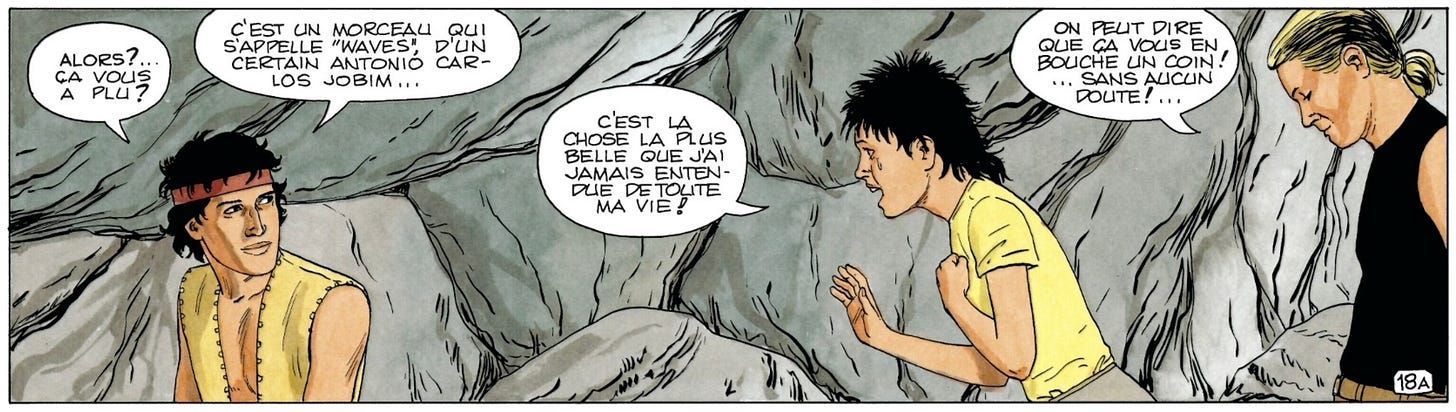
Image: Léo / Dargaud
The characters, by contrast, are simple, almost binary. Good people and bad people, drawn in stark ligne claire: women with exaggerated curves, nobody with lips, “good” men muscular and “bad” ones fat and balding. Not nuanced. But I needed that simplicity. It helped me get out of my head. Léo is Brazilian, saw a dictatorship. His politics bleed into the work in ways I don’t always agree with. But the worldbuilding is larger than his politics.
Music is forbidden on Aldébaran. But there’s a scene where a character named José plays “Waves” by Tom Jobim on the piano. That’s how I discovered bossa nova. I found the album later: Wave (1967), with its perfect cover art, blue and minimal. The connection between the comic and the music and the album art became another thread to follow.
Tom Jobim — “Wave”. The thread from an alien planet to bossa nova.
Years later, I read Alain Damasio’s La Horde du Contrevent and got the same feeling. A city called Alticcio. A city of towers built in a mountain pass, one of the last points in “la Bande de Contre”, where the secrets of the world are hidden in a library where all the books are its bricks. I read about Ne Jerkka, his face bent by the “Vif”. Damasio’s imagination stuck. The name stuck.
I named this project Studio Alticcio. A word from a French novel about wind. A city of towers. A library of bricks. That’s where I want it to reside.
What They Share
Frusciante overdubbed himself into an orchestra. Each listen reveals new strata. The Empyrean deserves FLAC.
Léo’s worldbuilding: simple drawings hide complex imagination. The author is not subtle, like Ayn Rand in that way. But the complexity lies elsewhere. There’s an encyclopedia of creatures and worlds Léo invented across his series. You see more detail every time you re-read, not in the drawings but in what they depict. Léo’s aliens are not-Brazil. The same light, the same colonial dynamics, the same sea, but elsewhere. You recognize it without being told.
Though his later work shows fatigue. Bellatrix, the latest series, feels like late Wes Anderson films. You can feel he’s tired. But that’s not why Léo is good. You read despite those limitations, not because of them.
Both works are good to read despite their flaws. Aldébaran for its simplicity and occasional crudeness. The Empyrean for being uncompromising in its vision and too complex to be performed live. Both offer the same thing: melancholic transcendence. Rising and grieving at once.
The Empyrean is about death and ascension. Frusciante made it during a spiritual crisis, returning to music after years of isolation. The album title means “the highest heaven” in Dante’s cosmology. But it’s transcendence through grief, not beyond it. You rise by accepting loss.
Aldébaran is about humanity’s colonial ambitions meeting something they can’t control. Beautiful alien worlds, but always danger underneath. The sublime against a backdrop of violence and mystery. “What could have been” haunts every panel.
I was seventeen, lying in my dim bedroom in the Vosges, headphones on, comic open in front of me. I was trying to transcend my circumstances. Both works promised that if I could just hear clearly enough, see the right colours, learn the beautiful names, I might escape to somewhere better.
The Education
This is curation: finding unexpected resonances. Not “if you like X, try Y”, but discovering that two things from different domains gave the same feeling. Following that feeling is how I did my grand tour.
what.cd and /mu/ taught me that serious engagement means following threads wherever they lead. Sometimes that’s Frusciante to Dante (even if Dante disappoints). Sometimes it’s Aldébaran to Tom Jobim to bossa nova. Sometimes it’s Aldébaran to La Horde du Contrevent to the word “alticcio” that named this project. Sometimes it’s finding a motherboard in a dump and feeling elated because now you can build the machine you always wanted.
My aesthetic education came from elsewhere. For outcasts, by outcasts. Internet subcultures, private torrent trackers, 4chan’s music board, fan sites like Invisible Movement. Being different meant going where “normal” people don’t go.
When I’m honest about the hierarchy of my feelings: Frusciante > Dante. The guitar layers moved me more than the circles of paradise. The comic about alien planets taught me more about beauty than the Divine Comedy.
The cultural accumulation worked, socially and otherwise. But I also got lost in my head. A sun and steel period followed, something to bring yourself back to Earth. But I still carry the taste for stratification. For quality. For names that sound like elsewhere. When Record Collection reissued the album, I bought the vinyl immediately. It felt like paying a debt to the thing that saved me. I named this project after a suspended city from a French novel. I still focus on the bass line in “Central” and rediscover the song.
The works I return to aren’t necessarily the most acclaimed. They’re the ones that stack. That play well together, that create resonances when combined. The Empyrean sounds different when you’ve read Aldébaran. Aldébaran looks different when you’ve heard The Empyrean. That’s the space I want to map.
That’s what Studio Alticcio is for.
—AB
First published at alticc.io on 25 December 2025. Last revised 5 July 2026.
Studio Alticcio is a place that doesn’t exist, producing essays about connections that shouldn’t exist.
🔥🔥🔥
Wow. Keep it up man ! Amazing content🫡