

The Noticing
The subscription agreement I was reviewing said, in the footer, “Page 47 of 112.”
It has never been printed. It will never be printed. It was drafted in Microsoft Word, negotiated in redline, executed on a signature platform, and filed as a PDF in a data room. At no point in its life will it come within ten metres of a printer.
And yet: page numbers, for pages that do not exist. Margins calibrated for a binder nobody owns. The words in witness whereof at the foot, as if someone might stand in the room. The document is a costume. A digital file dressed, carefully, as paper.
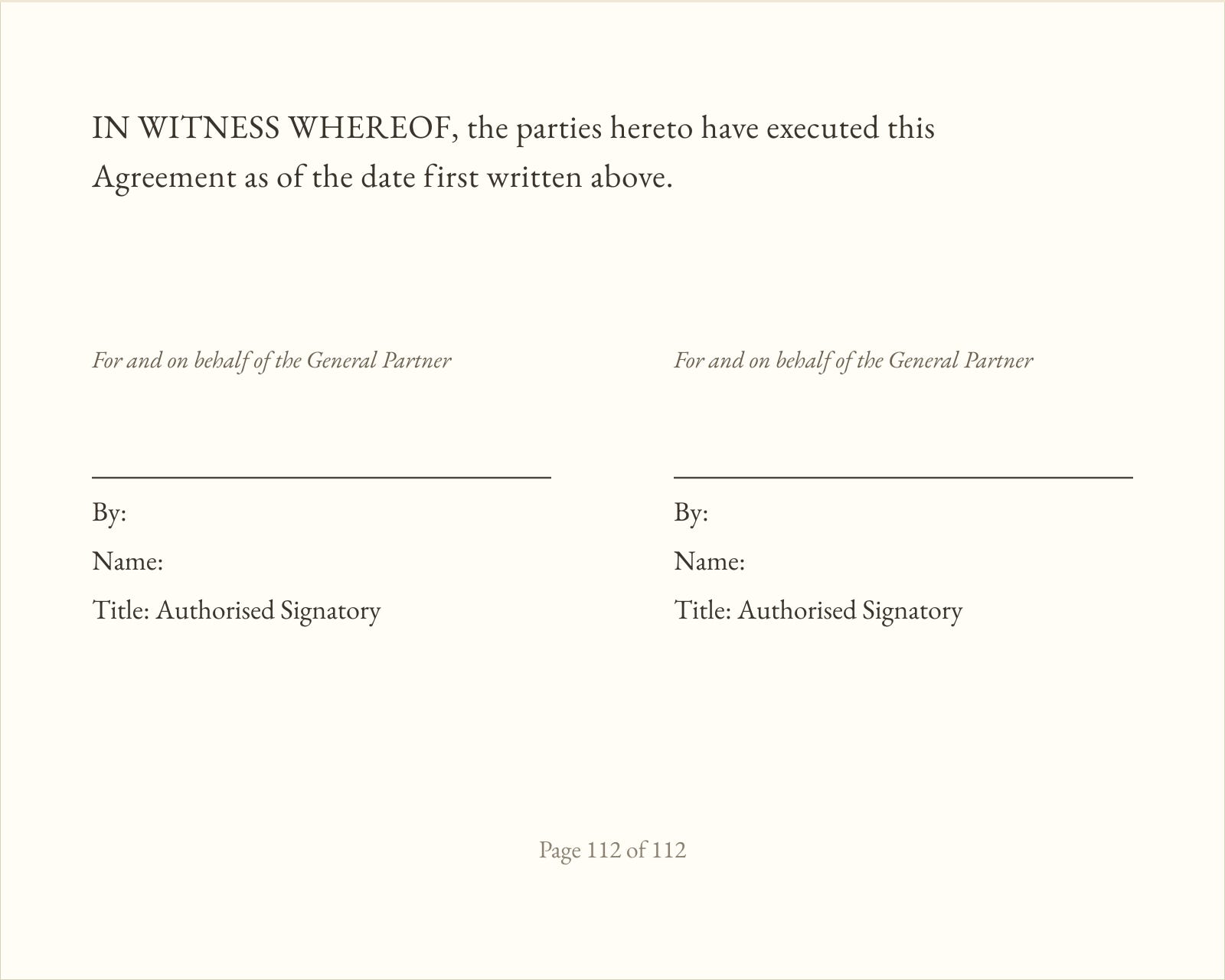
The last page of an agreement that will never be printed. It says in witness whereof. No witness signs; two of the party’s own authorised signatories do.
I first said this out loud in a car, driving home from Wiesbaden in December, somewhere in the dark between two exits. My fiancée got the long version. This essay is the longer one.
Every contract I have ever touched is haunted. The ghost is a sheet of paper. I wanted to know where it came from, why it stayed, and whether anyone should do something about it.
The Logic of Paper
None of it was decoration, at the start.
The witness came before the page. When a promise had to outlast the memory of the men who made it, you brought people to watch, and their watching was the record: a witness was a person you could send for, afterwards, to say what happened. The instinct is old and close to universal.
The longest verse in the Qur’an, Al-Baqarah 2:282, the verse of debt, is in part a drafting manual: contract a debt for a fixed term, and you write it down, let a scribe set it down in justice, and call two witnesses, because doing so “is more just in the sight of Allah, and more convenient to establish evidence, and more likely to prevent doubt.” Roman testation gathered its seven sealing witnesses. The Mesopotamian rolled his cylinder seal into the wet clay beside theirs. English law still recites the choreography: signed, sealed and delivered, three physical acts with the wax between them. The Statute of Frauds of 1677 demanded writing because memories argue and paper does not. Every tradition reached, on its own, for the same two things: a record, and a body that had seen it made.
The witness line is not even ours. Luxembourg is civil law. An acte sous seing privé, which is what almost every contract is, never needed a witness at all; the watching was reserved for a few solemn acts and professionalised into an office, the notaire. So the IN WITNESS WHEREOF at the foot of a Luxembourg partnership agreement is a pure import, a common-law incantation that arrived inside London and New York templates and stayed. A ceremonial witness pinned to a document our own law says needs none: a ghost of paper wearing the ghost of another legal system.
Not that civil law travels light. Article 1325 of the Code civil wants a synallagmatic contract made in as many originals as there are parties. The recital is still typed faithfully, “made in two original copies,” into agreements that will only ever exist as one PDF and its infinite identical copies. Better still: Luxembourg amended the article in 2000 to exempt electronically signed deeds. The exemption is old enough to have finished law school. The recital gets typed anyway. This ghost survived its own explicit repeal.
We have wanted two originals for a very long time. Old Assyrian merchants, four thousand years ago, sealed a clay tablet inside a clay case and wrote the contract a second time on the case, so that the outer copy could be broken to check it against the inner one. Two originals, made in as many copies as there are parties, verified by destroying the envelope. Article 1325 is that instinct, minus the clay, minus the breaking, minus the point.
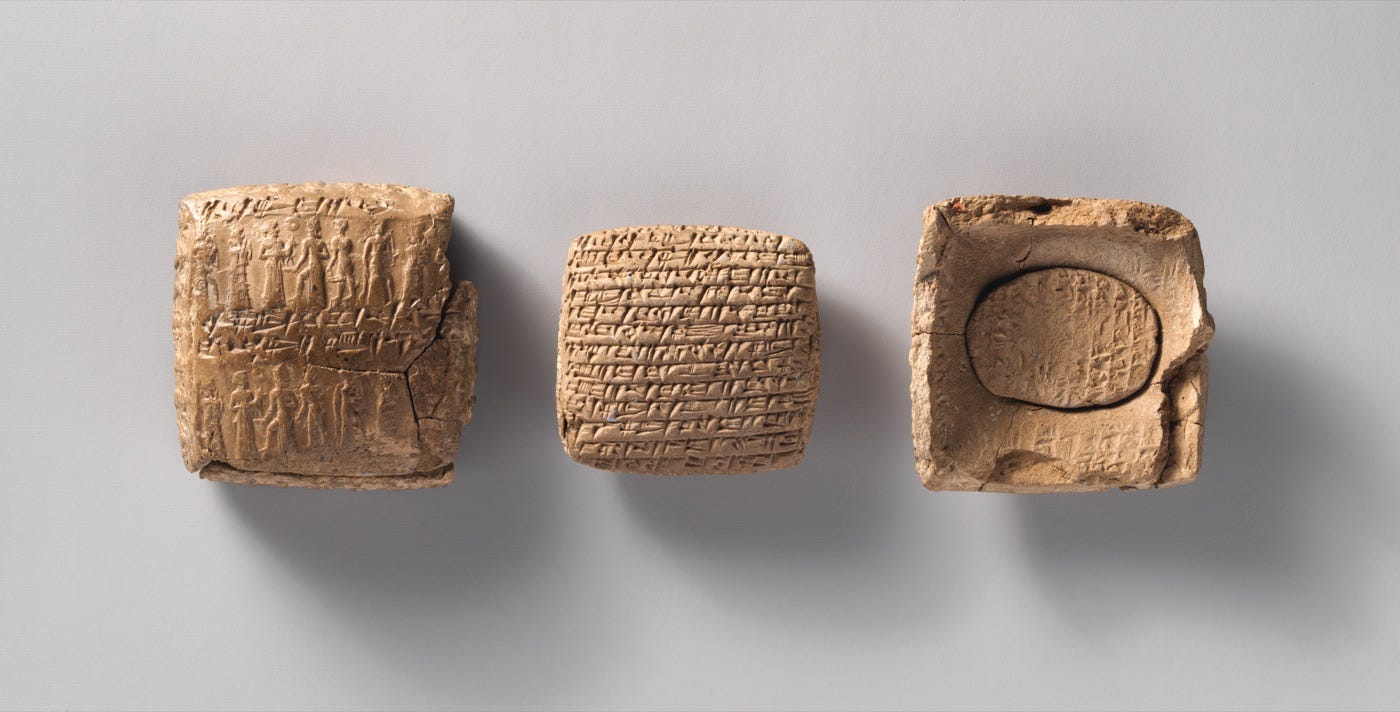
An Old Assyrian clay tablet, its sealed outer case, and the case broken open to reveal the tablet nested inside. Kanesh, ca. 20th–19th century BCE. The Metropolitan Museum of Art (1983.135.4a, b), CC0.
Pagination was a security feature. When a contract was a stack of loose sheets, a page could be shuffled, substituted, stolen. “Page 47 of 112” meant: count them. Initials on every page meant: nobody swapped one while you slept. Even the paper sizes carry folklore: the legend says lawyers cut foolscap in half and that Henry VIII fixed the length; the boring truth is a 1921 American standards committee quartering master sheets. Foolscap itself was named for its watermark, a fool’s cap pressed into the fibres. There has always been a joke hidden in the page.
The margins go back further than binding, if you believe Fustel de Coulanges. In La Cité antique he reconstructs an archaic city where the boundary of a family’s ground was itself a god, and two houses were therefore forbidden to share a wall: deux maisons ne doivent pas se toucher; la mitoyenneté est une chose réputée impossible. A consecrated strip had to run between them, and at Rome the law fixed its width at two and a half feet and gave it to the dieu de l’enceinte, the god of the enclosure. Party walls, the thing my property-law colleagues spend careers apportioning, were once a theological impossibility, because a small god lived in the gap.
The margin of a contract is that strip. We call it whitespace. Nothing presses against the edge of an A4 page now: no facing house, no binding, no neighbouring column. The document keeps its two and a half centimeters of consecrated air anyway, because the edge of a bounded thing is the oldest place we have ever kept a small god.
Every convention had a body attached. The witness was someone you could send for. The seal was warm wax. The page was an object that could be shuffled or stolen.
Buddy
Then, on 30 June 2000, in Congress Hall in Philadelphia, a few steps from where the Declaration was signed, Bill Clinton signed the E-SIGN Act. He signed it twice. Once with a pen, because the Constitution is old-fashioned about these things. Then he inserted a smart card into a reader and typed his password: Buddy. His dog’s name. With that, online contracts would have, in his words, “the same legal force as equivalent paper contracts.”
Europe followed with more paperwork and less dog. eIDAS, Regulation 910/2014, in force for signatures since July 2016, Article 25: a qualified electronic signature “shall have the equivalent legal effect of a handwritten signature.” Luxembourg had been early, as it tends to be when the product is trust: the loi du 14 août 2000 on electronic commerce, later aligned with eIDAS.
Here is what interests me about that morning in Philadelphia: it repealed the physics of an entire document culture, and visually, nothing happened. No contract looked different the next day. The witness lines stayed. The initial blocks stayed. The footer kept counting pages. The logic broke and the form did not notice, because the form is how the logic gets remembered, and nobody sent the form a memo. The memo would have looked exactly like all the previous memos.
The real signature, since that day, is a string of alphanumeric gibberish. The law was rewritten around a cryptographic hash, authenticated, that morning, by the name of a labrador.
The Squiggle
Sign something on a phone today and a platform will invite you to draw a squiggle with your finger, or to “adopt” a pre-drawn one in a fake handwriting font. The squiggle does nothing. Legally, the signature is the cryptographic operation underneath, a hash sealed with a key. The squiggle exists for one purpose: so that humans feel a signature has taken place.
The squiggle has always been an object rather than a hand. The Mesopotamians did not sign; they owned a cylinder seal, a little engraved stone they rolled across the wet clay to leave a picture that was theirs, and rolled again on the next contract, identical. The mark was not the movement of a hand but the print of a possession. “Adopt a signature,” says the platform, and hands you a stone.
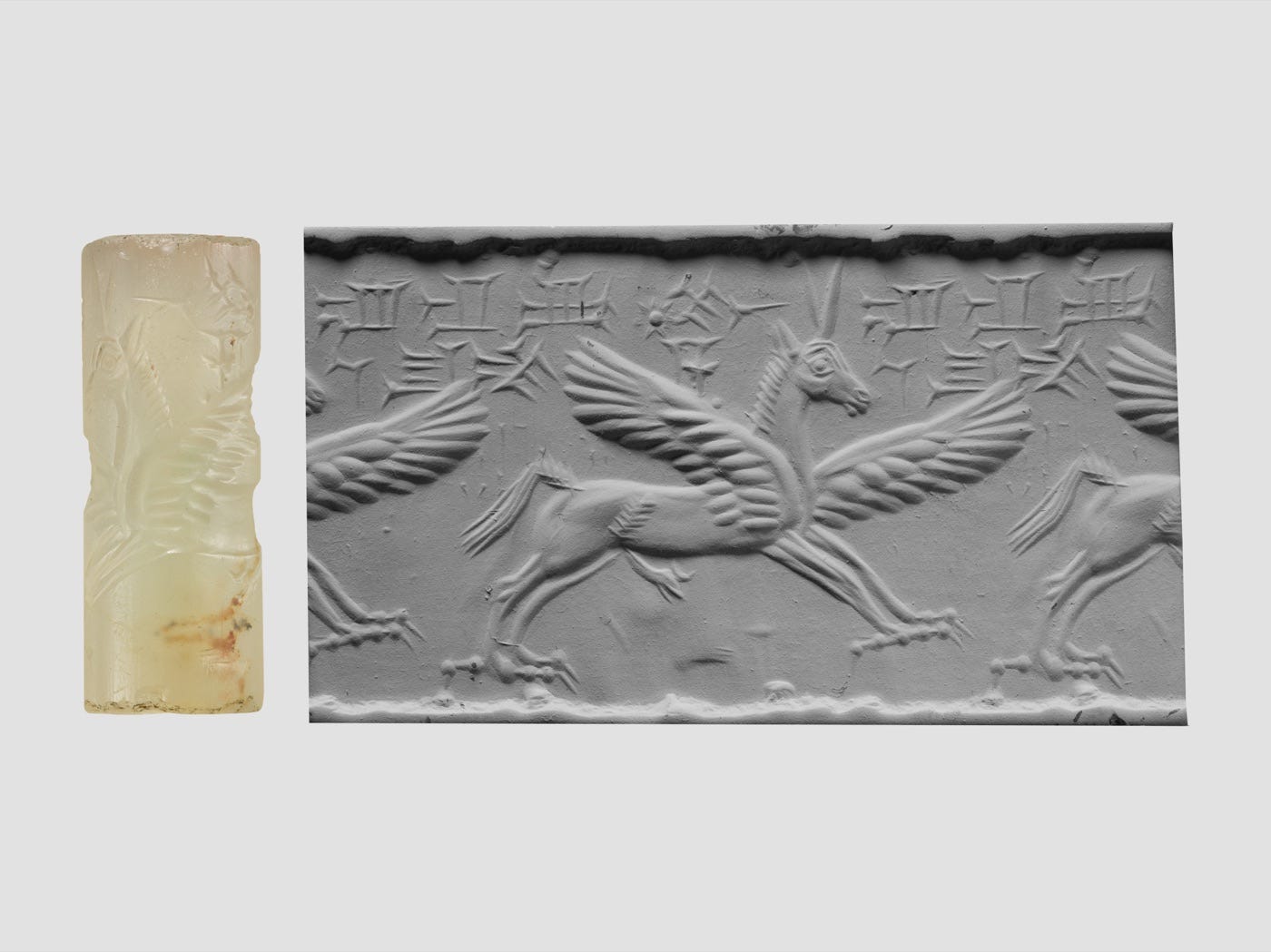
A chalcedony cylinder seal and the impression it rolls: a winged horse and its owner’s name in cuneiform. Assyria, ca. 14th–13th century BCE. The Metropolitan Museum of Art (1999.325.89), CC0.
There is a word for this. A skeuomorph: an ornament that used to be a necessity. Software went through its skeuomorphic fever openly. Apple’s Calendar app wore stitched leather copied from the seats of Steve Jobs’ Gulfstream jet; iBooks turned fake pages; Notes was a yellow legal pad. Then iOS 7, June 2013, flattened all of it. Apple gave its ghosts about six years. Law is at twenty-five and counting.
The tell is everywhere once you look. Email still carries a “Cc” field, carbon copy, standardised into internet mail by 1975 when the carbon was already optional. The save icon is a floppy disk that most people clicking it have never held. Microsoft moved on twice, Times New Roman to Calibri in 2007, Calibri to Aptos in 2024, while legal documents kept the serif they were born in.
And the serif is the deepest tell of all. Those little feet on the letters are a print habit; the working rule was always serif for the page, sans-serif for the screen, because serifs were thought to carry the eye along a line of ink. Times New Roman was drawn in 1932 for The Times of London, to be read on newsprint. A contract now lives on a screen, wearing a typeface tuned for the one surface it will never touch. The letters of the present go unused. Gary Hustwit’s documentary Helvetica follows the 1957 Swiss sans-serif that became the lettering of airports and forms, so complete a victory that the eye stops registering it. A contract could wear the type of its own medium. It keeps the type of the medium it left, not by any decision but because the template opened that way. Matthew Butterick, the profession’s one great typographer, put it best: “Times New Roman is not a font choice so much as the absence of a font choice, like the blackness of deep space is not a color.”
Skeuomorphs are supposed to be transitional objects. Training wheels for the late adopters, kept until everyone trusts the new thing. Legal documents broke the pattern: the transition completed a generation ago, and the training wheels are still on. Which suggests they were never training wheels.
Cues for Silent Gods
In 1976 a Princeton psychologist named Julian Jaynes published a book with an unreasonable title, The Origin of Consciousness in the Breakdown of the Bicameral Mind, and an unreasonable thesis: that Bronze Age people did not have an inner voice the way we do. They heard their thoughts as external voices, the voices of gods, and built their world as an apparatus for hearing them. The idols, the ziggurats, the oracles: cues, Jaynes says, to precipitate the voices. Then writing and trade and collapse forced minds to model other minds, the voices faded, and what grew in the silence is what we now call consciousness. The gods went quiet; the equipment remained.
His account of the end has a terrible elegance. Delphi ran on momentum for centuries, prophesying to tourists. Jaynes: “In AD 363, Emperor Julian tried to rehabilitate Delphi, and through his remaining priestess, Apollo prophesied that he would never prophesy again. And the prophecy came true.” The classical version of that last oracle, delivered to the emperor’s physician, ends: the speaking water has been silenced. Modern scholars suspect the whole story is a later Christian forgery. The god’s final attestation may itself be fake. I cannot think of a more on-theme footnote: even the record of the silence has a forged signature.
Jaynes is almost certainly wrong about the Bronze Age. He is exactly right about my documents.
Because that is what a witness line is. An idol. A cue built to precipitate a presence: the person in the room, the hand on the page, the watching. The presence stopped coming, gradually, then officially, one morning in Philadelphia in 2000. We kept the cue. We print, so to speak, little empty temples down the last page of every agreement, signature block after signature block, each one a room kept ready for a small god who no longer attends. In Luxembourg the temples are imported too, built to a god from someone else’s pantheon; the witness was never ours to summon in the first place.
The margin keeps its god as well, the one Fustel found standing at the Roman boundary. Between the signatory at the threshold and the consecrated strip at the edge, a contract is a small house with a deity posted at each opening, and we have gone on tending the shrines long after emigrating from the religion that built them. This is the domestic cult of the document: not one god who fell silent, but a whole household of them, still lodged in the layout.
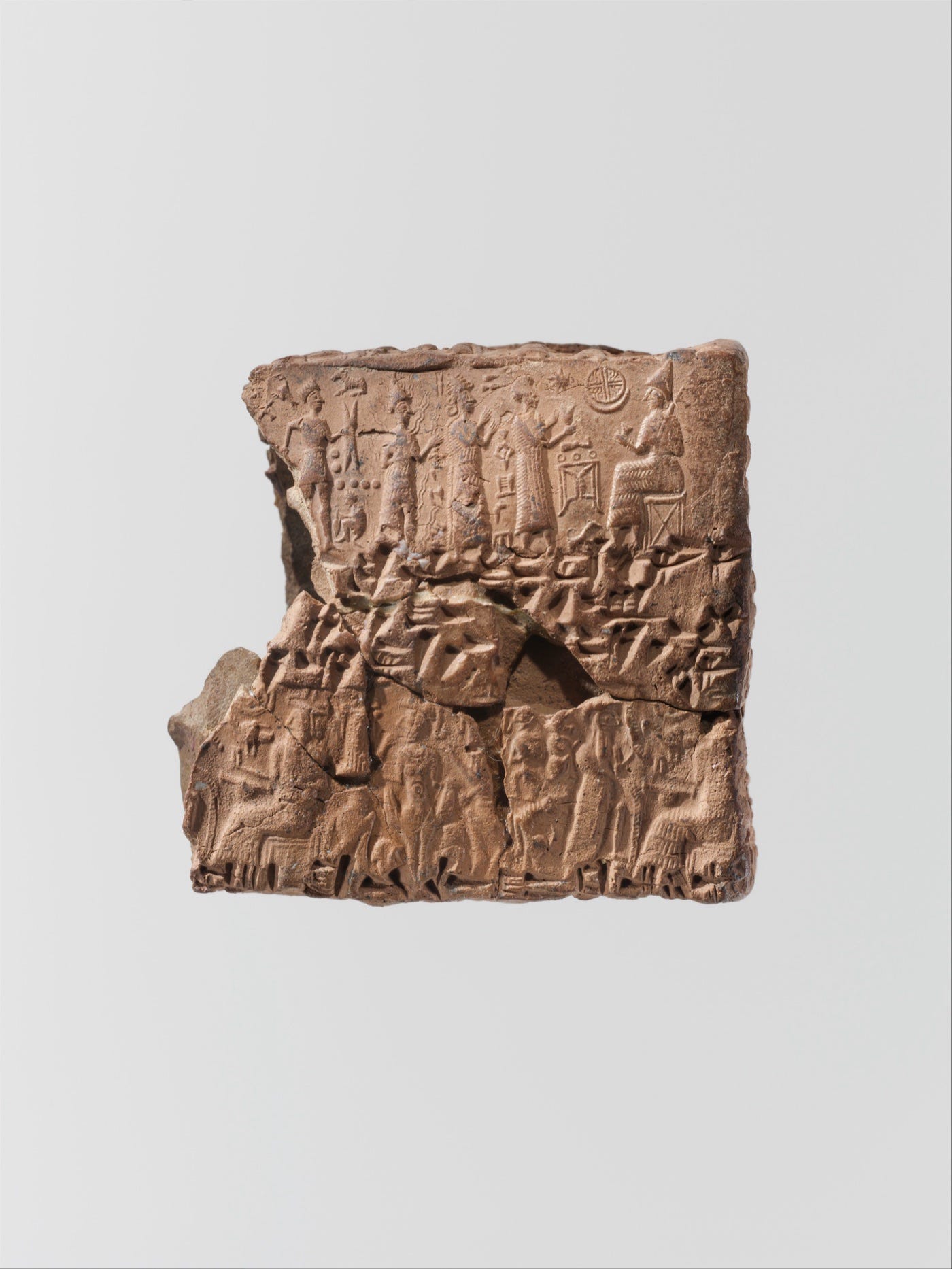
The clay case of a loan contract, its upper band impressed with the cylinder seals of the witnesses, broken to be read. Old Assyrian, ca. 20th–19th century BCE. The Metropolitan Museum of Art (66.245.16b), CC0. The witnesses signed by rolling; to verify their attestation you destroyed it.
In Schuiten’s La Tour the inhabitants find their world perfectly normal and the old paintings wonderfully strange; we find our documents normal, and it takes a long drive in the dark to notice that every one of them is an archaeological site.
The Minute
There is one place left in my professional life where attestation still works the way the form pretends it does. It is up a staircase in Luxembourg, at an étude de notaire.
Civil law kept one real watcher, for the acts it holds too heavy for private hands: incorporations, property, marriage contracts. Everything I actually draft passes under private signature and never sees him. But for an acte authentique the parties still appear, in person or through a clerk holding proxies, the deed is read aloud, and everyone signs in wet ink. Then the notary does the thing no platform can imitate: he keeps it. The signed original, la minute, never leaves the étude; what you carry away is an expédition, a certified copy that says on its face that it is a copy. It is the last document I know where “original” still names an object. Article 1325’s originals dissolved into PDFs a generation ago; the minute has an address.
It is ending too. Since a law of 15 June 2023, in force that August, Luxembourg notarial deeds can be passed electronically, the appearance by videoconference, the signature by a qualified seal. Every deed but one: the will. For a notarial will you still come in person. The legislator digitised every room of the temple and flinched at the last door, the one nearest to death. Somewhere in that exception is the whole argument of this essay, made by parliament.
The rest of us certify without the attending. The signature arrives overnight from another timezone; the squiggle was adopted, not drawn; the witness line, where our imported templates still carry one, was signed by nobody. The ledger has to balance anyway.
What the Ghost Holds
The honest ending would be an exorcism. I do not quite believe in it.
Legal theory has an old answer for why formalities exist, and it is better than nostalgia. Lon Fuller called it the cautionary function of form, back in 1941: the ceremony exists to slow your hand. The wax, the witness, the weight of the stack; they made promising feel like what it is, which is dangerous. A document that looks like a contract gets read like a contract, or at least gets feared like one. But a form does this only while you still feel it, and the Times New Roman nobody chose is a form nobody feels; a solemnity you have stopped seeing may have quietly stopped working. That is the real risk, worse than losing the ghost: keeping it, and no longer being moved by it.
Other trades have measured their ghosts. Medicine dosed the costume directly: in a JAMA experiment, the same placebo painkiller relieved far less pain once its stated price dropped from $2.50 to ten cents a pill. Nothing inside either pill. The form was the dose. Our own case has been run too. Eileen Chou’s experiments found that e-signed documents carry a weaker sense of the signer’s presence, inspire less trust, and are expected to be breached more often, across every style of e-signature she tested. The squiggle was doing work. So was the wax.
The Last Psychiatrist made the deepest version of the point, about funerals: the rite works precisely when you follow the steps blindly. Grief does not need you to improvise; it needs the form to hold while you cannot. “There is no shortcut to mourning, the shortcut leads to madness.” Formality is not the opposite of feeling. It is the container that keeps the feeling survivable. A consecrated boundary is the same thing turned inside out: the sacred is the shape we give to whatever we cannot otherwise hold, a grief or a promise that will bind us for a decade. Strip the ghost out entirely, render the terms as a slick scrolling web page, and you may discover that the solemnity was load-bearing. I once wrote a thesis defending law’s refusal to become code; I am not going to pretend the ghost has no function.
But between the haunted page and the exorcised one there is an unexplored room. Every other text I touch is medium-aware: it reflows on a phone, speaks itself aloud to a screen reader, prints when printing is wanted. The contract is the last fixed-layout text produced in industrial quantities, frozen at A4, and the freeze is not law, it is habit wearing law’s clothes. Call the alternative a responsive contract: same operative terms, one authoritative content, rendered for the medium and the reader. In December 2025 the phrase returned zero search results. I checked again this week; the contract design people are redesigning documents, the pattern libraries are visualising clauses, and still nobody has claimed the simple idea that a contract could know what it is being read on. An empty page, in the good sense, for once.
That is only the near wall of the room. The responsive contract still takes the document for a document, a thing to be read, and asks it to read well on a screen. Further in, the assumption itself gives way. Strip a subscription agreement to what actually operates and most of it is inert: recital, ceremony, the small gods, form that persists because form persists. A few sentences are not. A threshold, a category, the one clause that decides in hard money who is allowed to put money in: that sentence does not describe a rule, it is one, and a rule owes nothing to paper. It could be lifted clean off the page and run. The thesis I wrote defending law’s refusal to become code holds for most of law, the interpretive part, the part that needs a human in the room. But maybe the refusal was too total, and law should keep refusing for everything that was ever judgment while ceasing to refuse for the few clauses that were only ever logic. That is the essay I am writing next.
What would we lose if we let go of the page? I still do not have a clean answer. The question arrived in the dark between two exits, and we turned it over the rest of the way home; you have just read my half of the conversation, four sections too long, the way car conversations always are when you finally write them down.
Page 47 of 112 is still there in the footer. Nobody will ever hold page 47; it cannot be shuffled or stolen anymore, only cited. The witness line is still there too. I have stopped reading it as a lie. It is an idol, a small empty temple at the bottom of the last page, a room kept ready. At Delphi the speaking water went silent and they ran the oracle anyway, for centuries, on the strength of the architecture. We are somewhere in those centuries now. The paper has stopped speaking. The forms still know how to listen.
—AB
First published 11 July 2026 at alticc.io. From an idea that arrived on the road home from Wiesbaden, December 2025; promised in the masthead since then.